


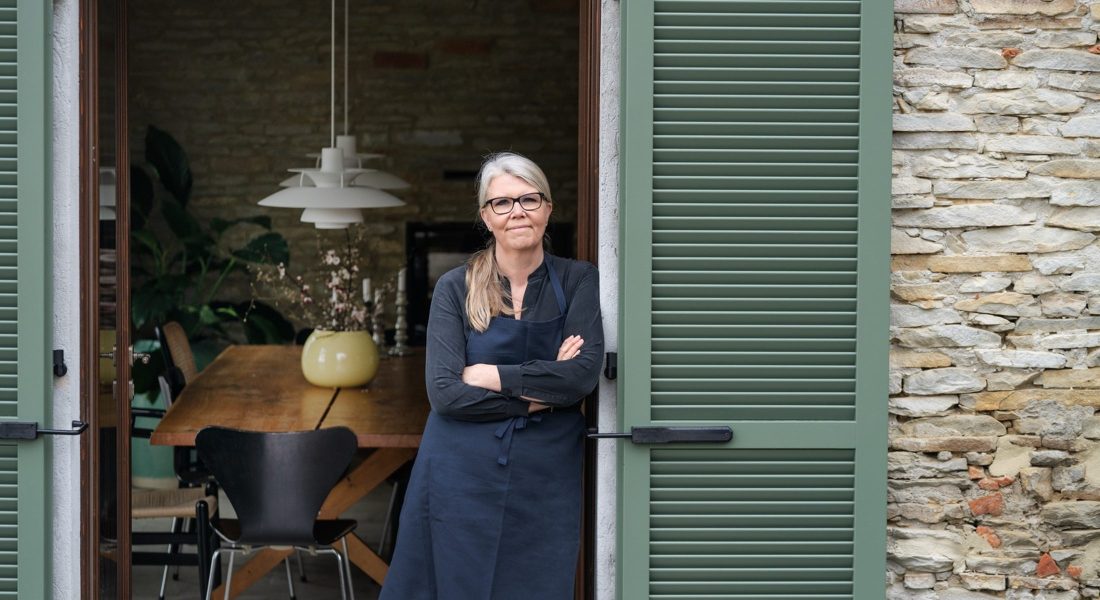
In conversation with Trine Hahnemann
Trine Hahnemann is an extraordinary and fascinating human.
She has owned three dynamic companies, each of impressive dimensions – the first specialised in tour catering for rock bands, and you can only imagine the stories that accompany that. Her next renaissance was a catering firm servicing canteens for companies and the government in Copenhagen – many important mouths fed, many challenges navigated. Finally, she opened a large food space in Copenhagen with a café, patisserie, bakery and cooking school.
She has written more than 20 excellent cookbooks that translate her passion to your kitchen (details of her latest release below), is a brilliant writer featured regularly in top press publications around the world and, thanks to her multiple and regular television appearances, is nothing short of a Danish national treasure.
Today, Trine divides her time between Copenhagen, London and Piemonte, in the north-west of Italy, with her wonderful husband Peter. They have restored and rebuilt their beautiful home in Piemonte to suit their lives – the kitchen is the heart of the house, the study balances this with its cool Nordic minimalism and the orto is Trine’s pride and joy – an ode to everything she is about: growing, observing, learning and improving.
A move to the countryside at this point in your life often signals a step towards retirement, but you would be very wrong to think this of Trine – she is a rocket of projects, investing every waking moment in sharing her knowledge and expertise about food, food business, fine ingredients and her absolute belief that food can heal all wounds.
She is a person that gives you hope in the future – her energy, her constant ability to reinvent, repurpose, rebuild and create from scratch is infectious. Spending even a short amount of time in her company feels like a privilege. If you get the chance to attend a day’s cooking class at her home, don’t pass it up.
We caught up at her home and I had the chance to ask her a few questions about her life.
“Cooking chose me”. You have had a naturally curious palate and a tuned sense of smell and taste since childhood. What is the greatest lesson that cooking has shown you?
That everything is about cooking and food. You can solve all the problems that we are facing in the world through food if you want to.
What do you consider to be the most distinct features differentiating Danish and Italian kitchens?
The base lines of our two cuisines are focused on a few ingredients. So, typically you use one spice at a time, for example. Neither culture overcomplicates a recipe. But unfortunately I feel as if Danes are losing their cooking skills faster than Italians and we don’t appreciate the importance of sitting down for a meal. Lunch is respected fully in Italy – you stop your work to eat and give respect to the moment and the food in front of you.
What brought you to Piemonte?
Peter wanted to live in Italy and that was the plan since we met. He lived here when he was young and he wanted to move back. I felt a draw to the UK but he won! I have been visiting Piemonte from a food angle for many years and I also loved the idea of living in the middle of Europe and being able to reach the continent easily. Growing up in Denmark I always felt as if I was on the top of Europe and I like to be in the middle of it so that I can be more interconnected with the wonders of the central European countries.
I also wanted to live in the countryside and, having worked with organic ingredients and so many different farmers over three decades, I really wanted to experience this for myself, to get to know it totally and begin living it on the inside. In Denmark there is more of a monoculture – it’s also harder to live year-round in the countryside because things shut down for the winter months. Here we have a small town of 10,000 people nearby and there are five cafés, a wonderful butcher, you can go into town for an aperitif; everywhere you look there is life. This is where I want to be as I grow older – Italy loves older people and I feel really well here.
You have an incredible orto that you have created – what are the current challenges you face in growing your own vegetables?
To understand the soil, it’s complicated. And to understand how much to water – you have to get to know it. Why does something thrive and something just doesn’t flourish at all? But this year (my third year) I had the most beautiful aubergines. In contrast, this year I have fewer tomatoes. It keeps you in tune with the climate and the seasons. It is a constant journey of learning.
I get up early in the morning and try to listen to what’s going on and observe. The caprioli (roe deer) are my greatest challenge – they think I’ve laid out a buffet for them. They love the Swiss chard and the tops of my chillies and they ate all of my white aubergine plants. They rock the tomato plants and knock them over. Until now I haven’t had issues with cinghiale, thankfully. We are in a hunting reserve so life is all around us. The hunters have access to our land and in exchange they bring me a part of their bounty – it is a wonderful exchange. The gift of food is something that changes your mood and impacts you profoundly.
Seasonality of ingredients is a central core belief for you – how do you perceive the seasonality of Extra Virgin Olive Oil and how it alters as an ingredient throughout the year?
I never connected the dots about the seasonality of olive oil and how it changes with the other seasonal ingredients throughout the year. I find the more technical things we discussed today very interesting and every time I discover something like this it makes me so full of joy and yes, of course nature has made it like that! This puzzle that we have blown into pieces deserves to be put back together and knowledge is the way to do this. There is so much meaning to food and the fact that you can keep exploring and understanding it is a huge privilege.
Do you have a favourite olive cultivar that you tend to gravitate towards or a particular style of olive oil that you prefer?
I have gravitated towards Tuscan olive oils historically as this was what I knew, but since living here I have discovered Taggiasca from Liguria and love this for its delicacy. I would always go to small growers in Tuscany and buy my olive oil directly. The more I understand olive oil, the more curious I become.
What is your view on using Extra Virgin Olive Oil to bake with?
I love that. Firstly, I really like to bake cakes with it and also I do a wonderful sourdough rye pancake and this works really well with olive oil. It is also fabulous if you bake fruit with a little sugar in the oven, served with a light goat’s cheese cream. Over ice cream it is a dream. And I would like to develop a really nice oat cookie with olive oil so that you can legitimately have a cookie for breakfast and it can be good for you.
Can Extra Virgin Olive Oil ever play a central role in Nordic cuisine?
Yes, it can, and it does already, but we need to go to the next step to understand the quality and the journey you can go on with fine Extra Virgin Olive Oil. I am one of the greatest advocates of olive oil. And if you live in Denmark, you can consider Italian olive oil to be local – Europe is our vegetable garden.
Only 8% of fruit in Denmark is grown nationally and 20% of vegetables. We need to see Europe as a whole and utilise what we have. Extra Virgin Olive Oil works so well with so many of the preferred Nordic dishes. Some dishes, of course, are better with butter, and that will stay, but for everyday cooking it is the best. Personally, I also don’t like butter with eggs, so even for scrambled eggs I always use olive oil.
Trine Hahnemann’s latest book Midnight Sun is a brilliant collection of summer recipes to inspire the home cook. The dishes she creates suit different moments in the day, from morning breakfasts to archipelago picnics and afternoon fika. She also has many ideas on preserving the late summer goodness for the colder months ahead. It is available now from all good bookstores or online.