


The Magical Tortellini of Castelfranco Emilia
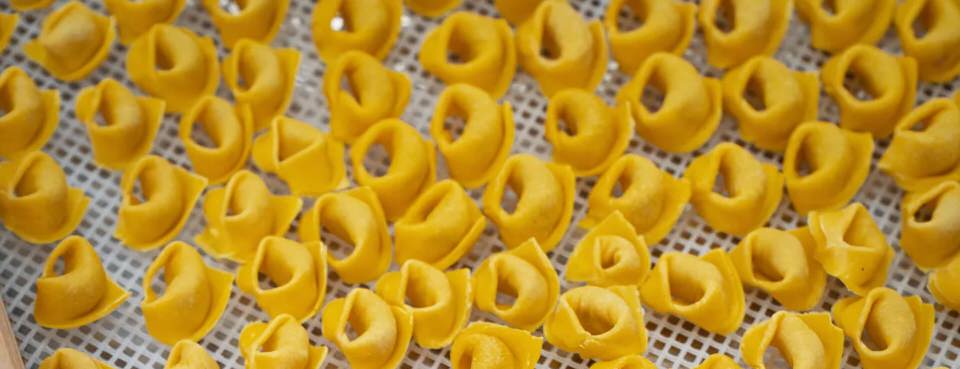
In his 1624 poem La Secchia Rapita (The Stolen Bucket), Modenese poet Alessandro Tassoni recounts a tale from the 1325 battle in which Venus, Bacchus, and Mars stopped at La Corona, an inn in Castelfranco Emilia that still operates today. According to legend, a Bolognese innkeeper, mesmerized by the beauty of the nude goddess, sought to immortalize her navel in the form of a delicate, meat-filled egg pasta – what we now know as tortellini.
This story has been lovingly preserved by generations of rezdôre – the women of Emilia who expertly roll out pasta dough by hand. Traditionally, while the rezdôre shaped the pasta, the men were responsible for preparing the filling. More than just skilled artisans, the rezdôra was the cornerstone of the household, managing its resources with precision. The rolling pin – known in dialect as the cannella or matarela – was often passed down through generations, even included in a bride’s dowry as a symbol of tradition and culinary mastery.
The original recipe for the filling of a tortellino varies from family to family, but frequently, you hear of the following proportions: 3 parts pork, 1 part prosciutto and a small amount of mortadella, cooked together. Once cold, you then season with a generous amount of Parmigiano Reggiano and a pinch of nutmeg.
There are also secrets when it comes to the dough and some believe that allowing it to rest for at least a couple of hours has an impact. You begin rolling it out from the centre and work towards the outside. There is also a theory that you shouldn’t add flour, because this way the broth stays clear. All of this should be coupled with a calm mind when you begin to roll the dough.
These repetitive preparations can be meditative, reassuring. They allow us to clear our minds of the daily grind by the fact that they are precise, rigourous practices. You can work on this alone, or with your family and when you bring the results to the table, there is a sense of deep happiness. The kitchen, in Italy, still keeps the family together.
For humble families, tortellini were prepared for celebrations, such as the feast of S. Antonio (17 January), the patron saint of farmers and livestock, a hugely important festival for those living in the countryside. They were also always served at Easter, at Christmas and during the August holidays.
If you love Tortellini, it is worth visiting the festival that honours the traditional Castelfranco Emilia tortellino held annually in September. There is also a truly great social laboratory called il Tortellante that if you are in the area, you should visit – it is a school of autonomy and you can also buy the results of their labours.